

Collection and delivery
Some machines leave the outlet on a client trailer, while others need a crate, a tail-lift truck and careful offloading. Collection, handover and site readiness all need to be aligned before the unit moves.
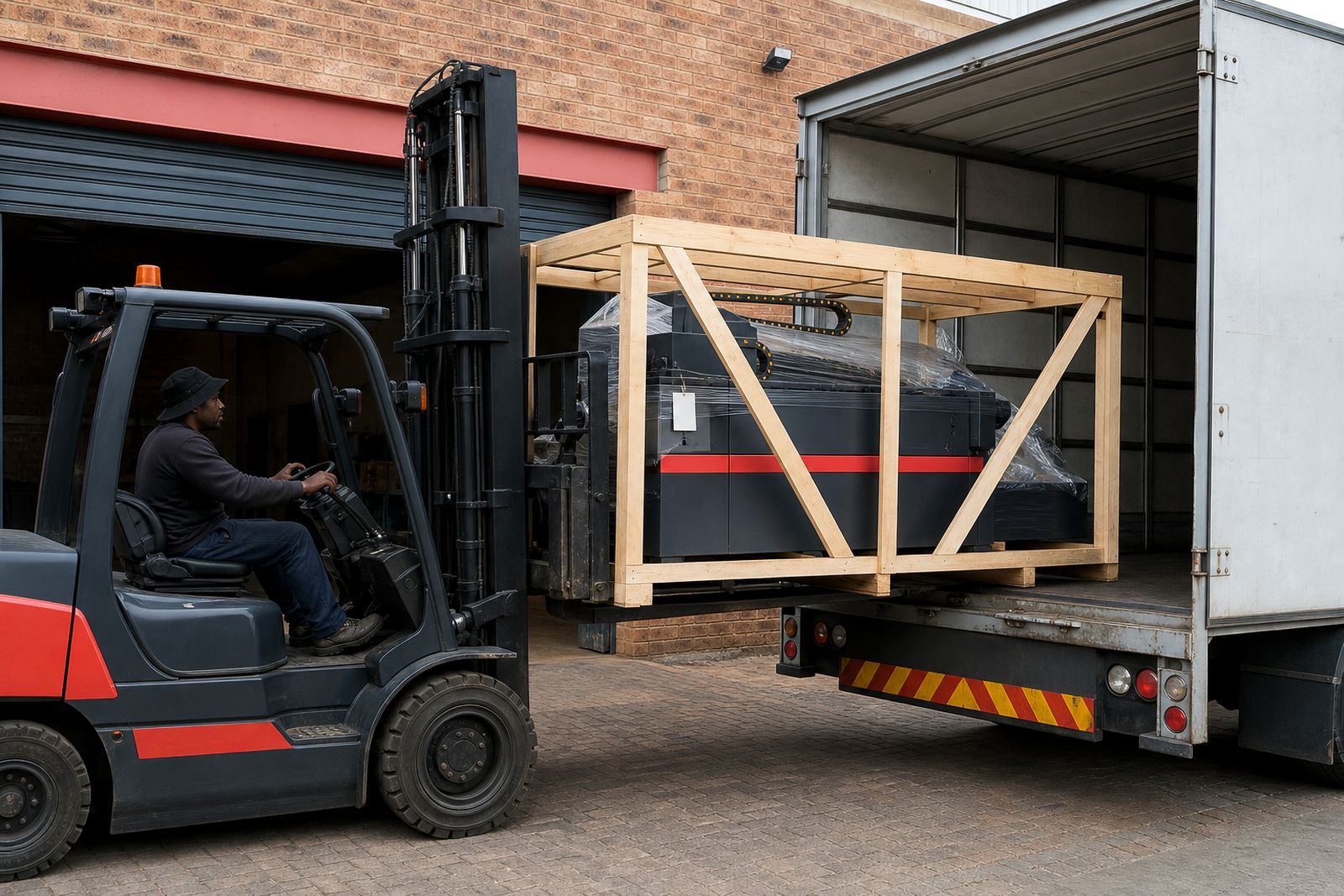
Two ways the machine can leave the outlet
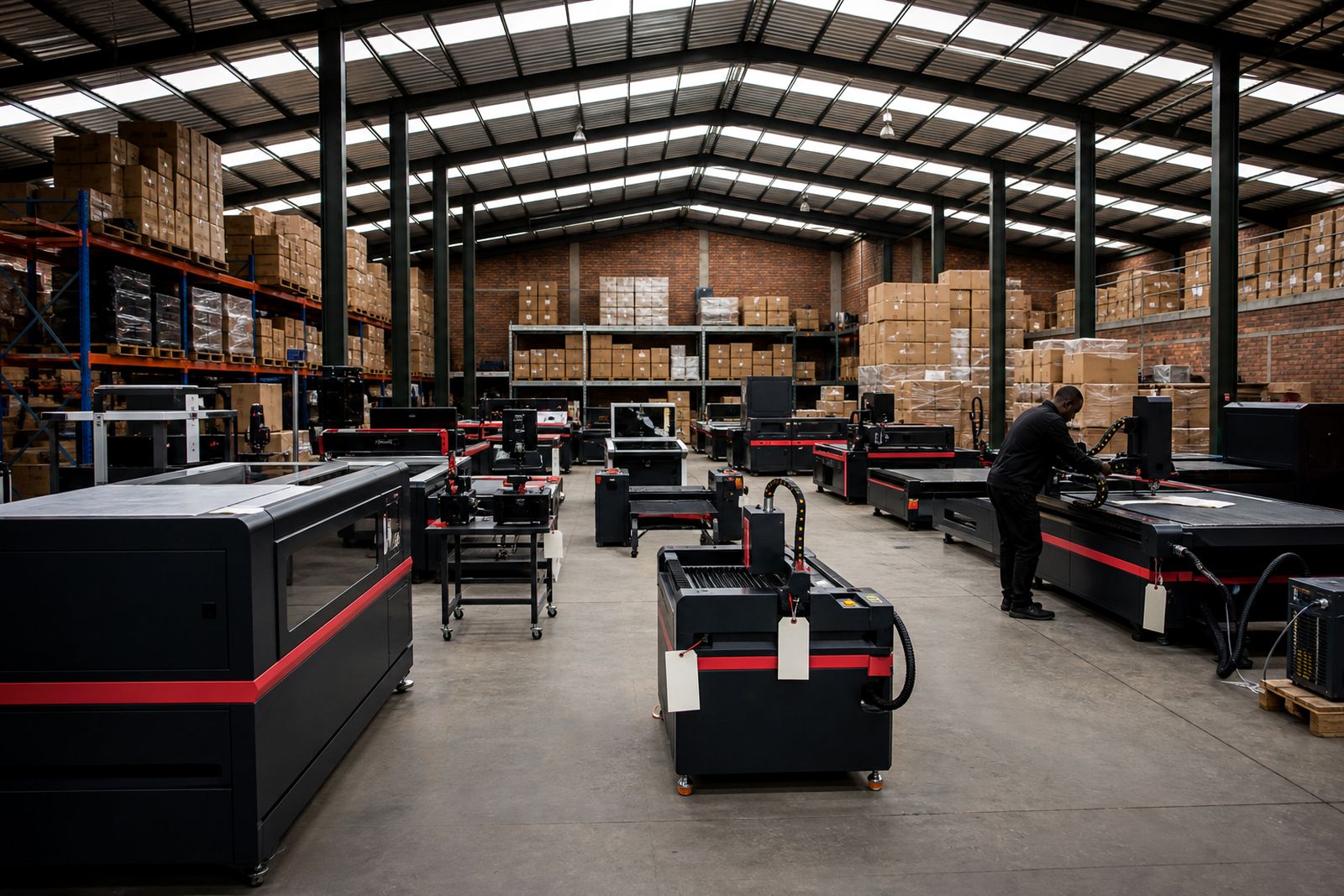
Every special is marked for either collection from Pretoria West, delivery to site, or both depending on size and handling risk. Smaller cutters, bench lasers, compact 3D printers and boxed spares are often straightforward to collect, while larger routers, print equipment and heavier floor-standing units usually need a booked vehicle and planned offload.
- Client collection from our Pretoria West outlet by prior arrangement.
- Delivery across Gauteng and the rest of South Africa.
- Crating or protective wrapping where the item needs it for road transport.
- Loading at the outlet with lifting equipment suited to the unit.
- Offloading on arrival where this forms part of the booked delivery method.
Not every item travels the same way. Ex-demo stock may already sit on a base frame or pallet, while end-of-line boxed stock can often go out as packed goods with less handling.
What is included in a booked delivery
A booked delivery covers the movement from our outlet to the address agreed for the special. That normally includes preparing the item for travel, securing loose parts, strapping, protective wrapping, loading, transport and offloading with the vehicle or lifting method chosen for that machine.
Where a timber crate is needed, it is sized to the footprint and transport risk of the machine. It is built to suit the order instead of using one standard box for every unit. Control units, water systems, extraction parts, stands and accessory cartons are packed as separate pieces when that reduces movement and helps with safer handling on arrival.
- Basic travel protection for painted panels, rails, lenses, screens and covers where relevant.
- Palletising or crating for machines that should not move loose in transit.
- Route planning for height, access and long-distance linehaul where needed.
- Offload planning for forklifts, pallet jacks, tail-lifts or crane access.
- Handover against the item description and visible condition at delivery.
Workshop positioning depends on access and the booked handling method. If a machine must go past a roller door, over a threshold, into a basement area or onto a mezzanine, that has to be raised before transport is booked.
How the handover runs from outlet to site
The first step is choosing the special itself. Because this is a clearance outlet, availability is tied to live stock counts and the deal end date shown on the item, so the transport method is matched to the exact unit rather than to a standing catalogue line.
Once the machine is identified, we confirm whether it leaves boxed, on a pallet, on its stand, or in a crate. Dimensions, mass and the number of loose cartons are then recorded for transport planning. Collection clients receive the pickup requirements, and delivery clients receive the transport basis and offload note.
Before dispatch, the machine is checked for moving parts, detachable accessories and any transport locks that should be fitted. On arrival, the unit is offloaded to the agreed point and checked for obvious transit damage before the driver leaves. Small marks on ex-demo units that were already part of the grade are not treated as transit damage.
What the client needs to prepare
Good access matters more than most people expect. A 1 300 x 2 500 mm router bed or a long print unit can be easy on a truck and awkward at the final ten metres if the gate opening, paving, ramps or turning circle are tight.
- Clear the receiving area and the route from gate to workshop floor.
- Measure door widths, roller shutter openings and ceiling height.
- Check whether a forklift, pallet jack or crane is needed on your side.
- Make sure someone authorised is present for handover and sign-off.
- Tell us early about gravel driveways, steep slopes, soft ground or loading bays with restricted hours.
If the machine is going into a shared complex, industrial park or municipal site, access rules and booking slots should be confirmed in advance. Coastal deliveries also need sensible storage on arrival so wrapped equipment does not sit in damp air for days before unpacking.
How delivery pricing is worked out
Transport is priced per movement. The amount depends on the size and mass of the machine, whether it needs a crate, the collection and destination points, the vehicle type, and the offloading method required on site.
A boxed bench unit moving within Gauteng is a different job from a crated router travelling to the Eastern Cape with a tail-lift truck and two handling points. Remote areas, farms, mines, high-security sites and addresses with limited truck access can add cost because the route or final vehicle may have to change.
We do not publish permanent list prices or written quotes for outlet stock. If you want us to work out the transport basis for a live special, send the item link, town, delivery suburb and any access limits through our contact form.
Aftercare once the unit is on your floor
After delivery or collection, keep the packing material until the item has been fully unpacked and checked against the special. If the unit was crated, remove the outer timber carefully and avoid levering against covers, cable chains, gantries or side panels.
Transit locks, protective films and loose accessory cartons should be dealt with before power-up or assembly. Ex-demo machines may have handover notes covering cosmetic marks, missing outer cartons or substituted packing, and those notes should stay with the machine records in your workshop.
For anything noticed after handover that appears linked to transport, log it promptly with photos of the packaging and the affected area using our contact form. For collection jobs, the load restraint on the client vehicle remains the client's responsibility once the vehicle leaves the outlet.
What our Workshop Clearance customers say
Verified Google reviews
Questions we get asked
Can I send my own courier or truck?
You can, if the vehicle and load restraint suit the machine. The driver must arrive with the right capacity, tie-down points and any lifting equipment needed for the pickup method confirmed for that item.
Do all machines need a timber crate?
Some stock can travel safely in its original carton or on a wrapped pallet. Heavier or more delicate units may need a custom crate, especially on longer routes or where multiple handling stages are involved.
Will you place the machine exactly where it will operate?
That depends on access and the booked offload method. Standard delivery is to the agreed receiving point. Final positioning deeper inside the workshop must be discussed upfront if narrow passages, ramps or extra lifting are involved.
Tell us about the job
Send sizes, materials and where you are through our contact form, and we will come back with the practical options.
Open the contact form